Tuesday, 27 March 2012

Wild Bill and the importance of fatherhood


The East End of London is a familiar backdrop to the gangster, hard man film genre. But in Dexter Fletcher’s gritty and accomplished first movie, Wild Bill, the sink estates and building sites around the Olympic stadium provide his action with an emotional content and resonance. Fletcher introduces us to a part of London that is under reconstruction and this mirrors the moral project of the film’s central character, “Wild” Bill Hayward (Charlie Creed-Miles).

Bill is attempting to reconstruct his life after being banged up for eight years in Parkhurst prison for robbery and GBH. He is out on licence and planning to go straight. The question is will he be allowed to break with old-style East End omertà or will he be sucked back into the underworld of drug dealing and casual violence?

The ex-con returns to his family but finds that it is also in need of some radical reconstruction. His wife has run off to Spain with a fancy man, leaving behind her two sons, 15 year old Dean (Will Poulter) and 11 year old Jimmy (Sammy Williams). Dean has been acting as both father and mother to his younger brother while living a covert existence beneath the radar of social services in order to avoid being taken into care. Bill’s return releases in Dean all the repressed anger at his father’s desertion.

Yet, without Bill’s presence, Dean and Jimmy will be at the mercy of social services. Bill must learn from scratch how to be a father and his sons must learn to love and respect him as such. This is not a cosmetic makeover, but something that goes to the heart of how they understand themselves. The relationship between Bill and his sons develops a tensile strength like no other and gives a unique order to their relationship.

Wild Bill is set in a macho environment where threat and force have become flaccid expressions of manhood. The flexing of tattooed East End muscle and menacing attitudes look Neanderthal. But, in the fatherhood of Bill and the response of his sons, we glimpse the inherent dignity of the masculine, where true strength is manifested in care, protection, tenderness and playfulness. Without sermonising, Wild Bill reminds us that young lads do well to have real dads. They benefit and so does society.

Dialogue as sharp as a Stanley knife and raw performances make Wild Bill all that and a bag of chips. It’s not scared to take on the Lock, Stock and Two Barrels clichés and credits its audience with intelligence and wit. This film can more than handle itself and deserves to be widely seen. Imagine The Wire set in Newham. Yes, it is that good. I wouldn’t be surprised if Dexter Fletcher and Creed-Miles replace their hoodies and trackie bottoms for something a little sharper as they pick up shiny gongs at awards ceremonies in the coming year.

Sunday, 18 March 2012

Sweeney Todd


I saw the original 1980 production of Stephen Sondheim’s Sweeney Todd at the Theatre Royal, Drury Lane. At the time, the critics damned his new musical with faint praise. They admired its cleverness but questioned its emotional detachment. A musical about revenge, serial killing and cannibalism was too much for a West End audience to stomach and it soon closed.

I have never been a great fan of musical theatre (too camp, too trite and too obvious for my tastes) but as a fourteen year old I was mesmerised by the musical ambition and lyrical wit of Sweeney Todd. Sitting in the gods at Drury Lane, watching Hal Prince's spectacular production, has become one of the defining moments of my theatre going life. I fell in love with the musical and, over time, I have become a devoted fan of the work of Stephen Sondheim.

Over the years I have seen countless productions of Sweeney Todd – including the famous 1993 National Theatre production, an Opera North production and a promenade performance with the opera singer, Bryn Terfel, singing the part of Sweeney. Tim Burton’s film version – though visually exciting – was, to my mind, a disappointment. Johnny Depp and Helena Bonham Carter had neither the musical or emotional range to make the relationship between Sweeney Todd and Mrs Lovett convincing.

Why has this musical (unlike any other) captured my imagination? I think it is the completeness of Sondheim’s musical venture and the lyrical perversities that continue to excite and startle. For example, what other musical would use a love song (“Pretty Women”) as throats are being slashed by a sociopath? Sondheim allows beauty and horror to cohabit in the same melodious, orchestrated line. Dissonant key-changes create an atmosphere of menace and even the lyrical sensuality of some of his orchestration acquires an erotic ambivalence. At every point, the audience is musically wrong footed and kept in a state of permanent suspense.


Sondheim’s lyrics straddle grand guignol melodrama and farce with a contortionist’s ease: “For what’s the sound of the world out there?/Those crunching noises pervading the air?/ it’s man devouring man, my dear,/ and who are we to deny it in here? ” Though set in Victorian England, Sondheim’s musical feels as contemporary and disturbing as American Psycho or We Need to Talk About Kevin.

Jonathan Kent’s new production of Sweeney Todd has just transferred to London and stars Michael Ball and Imelda Stauton. It is one of the darkest and most theatrically convincing productions of Sweeney Todd I have seen. The gothic visuals of Hammer House of Horror movies viewed through the lens of the Communist Manifesto. It's scary and thought provoking.

Michael Ball, every housewife’s Radio 2 crumpet, is unrecognisable. He has transformed himself into an obsessive, vengeful force who satiates his hatred by murdering the innocent. Imelda Staunton’s Mrs Lovett is a master class in comic timing while conveying the unique pain of unrequited love.

The Demon Barber of Fleet Street raises his razor again at the Adelphi Theatre. Kill for a ticket.

Wednesday, 7 March 2012

Travelling Light


Last week’s Oscar winner, The Artist, is about that liminal moment in cinema history when the silent movie became the talkie. It was also a salient reminder of the continuing influence of the Jewish community in Hollywood. The producer of The Artist is the indomitable, Harvey Weinstein.

Nicholas Wright’s new play, Travelling Light, is concerned with another liminal moment in cinema history – the moment when the still photograph became a moving picture and motion pictures were born. The play also highlights the fact that the birth of modern film took place within the Jewish community. These cinematic pioneers became the pilgrim fathers and mothers who took their new invention to America and laid the foundations for the Hollywood factory of dreams of Louis B Mayer and Samuel Goldwyn.

Travelling Light sees in the bustling life of the shtetl, the small town, the embryonic beginnings of cinema. A scene in the play, where the would be director, Maurice Montgomery, and his female assistant, realise that a length of continuous film can be spliced and glued together to form a new narrative is presented as significant as the invention of the combustion engine. It’s a wonderful Eureka moment. Man using his intellect, creativity and ingenuity to produce something that would provide another light with which we might interpret the world around us.

But why did the community of the shtetl become the focus for such inventiveness and creativity? In a programme note, the writer, Eva Hoffman, points to the moral centre at the heart of the shtetl:

Everyone within the shtetl’s small compass knew each other; and although there was clear social hierarchy, based on the values of wealth and religious learning, the importance of charity meant that not even the poorest or the most improvident were entirely rejected from the communal net. On the Sabbath, those who could not afford a proper meal were taken in by their more prosperous neighbours; and on those evening, the shtetl really did become a united organism, with Sabbath candles visible through each home’s windows....

What accounted for this outburst of inventiveness and creativity? Perhaps it was precisely the encounter between traditionalism and modernity; the disciplines of piety and religious reasoning colliding with new, turbulent social realities...such confrontations can liberate surprising forces of imagination and thought...

Travelling Light is a sentimental reimagining of the early days of cinema. All those eureka moments – editing, casting, continuity, cinematography, finance, etc – are celebrated with real warmth and humour in Wright’s play. When I next walk into the local cinema multiplex, I’ll remember with a new clarity the huge contribution that small Jewish communities made in providing pleasure, entertainment and stimulation to those millions of us who simply love the movies.

Travelling Light by Nicholas Wright is currently on at the National Theatre, London.

Monday, 27 February 2012

And the Oscar winner is...


The Artist
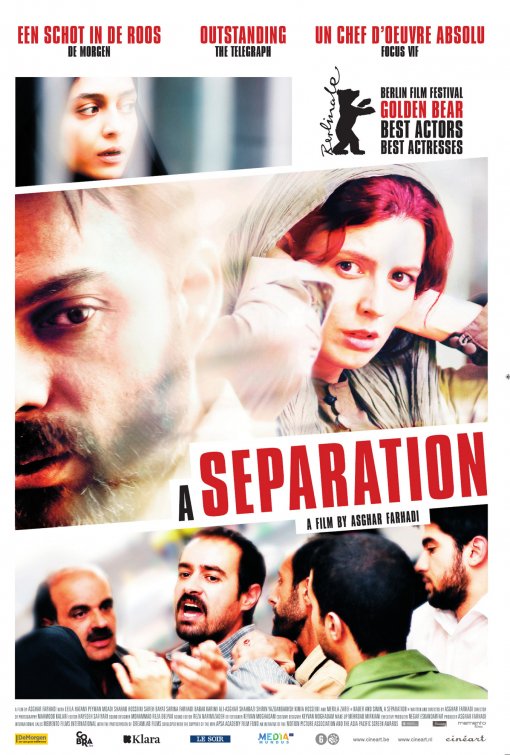
(a film I enjoyed as a novelty project but could not get really excited about) scoops the big prizes. But I was watching the Best Foreign Film category and, yes, the marvellous Iranian film, A Separation,wins.

Tuesday, 24 January 2012

Sport, depression and the death of Robert Enke


There is a strong fascist bias in our relationship to professional athletes. We expect them to be paradigms of physical and psychological strength. These are the men and women who have actively trained away the weaknesses of mind and body that most of us passively accept. They have achieved a state of perfection that sets them apart as superhuman. It is this we admire in them. It is this that fills stadiums, sells tickets and clinches sponsorship deals. We want them to wear a carapace of invincibility.

But should they show signs of frailty or weakness then, public adulation can quickly turn to disappointment. And, worse still, should this become a sustained weakness then the athlete will be exposed to an intense scrutiny under an exacting audience that usually results in them being expelled from the divine sporting pantheon. They fall to earth as figures of public pity or ridicule. Chad Harbach’s critically acclaimed novel, The Art of Fielding, nails this tension through the rise and fall of his baseball protagonist, Henry Skrimshander. He writes:

We all have our doubts and fragilities, but poor Henry had to face his in public at appointed times, with half the crowd anxiously counting on him and the other half cheering for him to fail.

This year’s William Hill Sports book of the year, A Life Too Short: The Tragedy of Robert Enke by Ronald Reng is a disturbing account of how public and professional expectations can place terrible pressures on sportspeople. While the rewards for those who excel in a particular sport may be enormous (both in terms of public acclaim and wealth), this can turn into a Faustian pact, with men and women trading their souls and, in some cases, losing their lives for the promise of success.

On 10 November 2009, Robert Enke, threw himself in front of a passing train. He was a goalkeeper for the German football team and would probably have represented his country at the 2010 World Cup. From an early age he was recognised as being an outstanding talent: physically strong, intelligent, with an instinctive sense of space, excellent reactions and a radar like sensitivity to the position of players and the ball. He was admired by both peers and fans as a formidable goalkeeping presence. But Robert Enke was also a man who suffered from severe bouts of clinical depression which he hid for fear of looking weak. After his first game for Fenerbahce in Turkey went disastrously wrong, Enke wrote in his diary:

11.08.2003. I’m finished. We lost the game 0-3. Didn’t look good from the first goal. After that I was very nervous in the second half. Was mocked by some of the fans...Would like to get away from Istanbul, do a proper course of therapy at last. At any rate, it can’t go on. Understood yesterday that I’m simply not up to the demands...Terri (his wife) just rang and had to put the phone down again to cry. I feel helpless and anxious. I don’t leave the hotel room, I’m afraid of people’s eyes. I’d just like to live without anxiety and nerves.

The emotional honesty of Enke’s diary entries provide valuable insights into the nature of depression itself – the feelings of isolation, anxiety and inertia. Reng gives us a clinical glimpse inside Enke’s head. But we also see how his position as an international goalkeeper compounds his anguish. The goalkeeper is the last line of defence. Everything is literally in his hands. Enke’s Barcelona team-mate, Victor Valdes talks of the goalie’s “special sort of suffering”. The goalkeeper is at once part of a team and a figure who stands alone. Tactical and defence errors may result in a goal but it is the goalkeeper who lets the goal in. He must live with this failure.


One psychiatrist who cared for Enke told him that his problem was that he had never learnt to live with his mistakes. He reminded the goalkeeper that “a mistake wasn’t the whole game, a game was never the whole season, a season wasn’t a career. A career isn’t a life.” Enke could accept the principle intellectually but he was incapable of integrating it into his personality. “If you could have my head for half an hour,” he told his wife, “you’d know why I go mad.”

Like so many sportspeople, Enke found it impossible to admit to his psychological and emotional difficulties. He kept burying them for fear of being outed as weak. This contributed to his unhappiness and mental dissolution. But recently some professional athletes have been willing to talk about how the pressures of their particular sport has played into their feelings of depression. Respected figures such as Marcus Trescothick, Jonny Wilkinson and Stan Collymore have spoken openly about the crushing self-doubt and emotional turmoil that they have battled with. They have brought this hidden subject out into the open. While we may fantasise that our sporting heroes are invincible, such brave testimonies remind us that sportsmen and women are not immune from the fragility of the human condition.

A Life Too Short: The Tragedy of Robert Enke by Ronald Reng, Yellow Jersey Press, London, 2011

Tuesday, 17 January 2012

Steve McQueen's Shame


Too much discussion has revolved around the raw images of loveless sex in Steve McQueen’s remarkable film, Shame. It is true that this is not a film for the prude. Yet, Shame is no arthouse exercise in soft porn, a vulgar excuse for adolescent prurience or a sexual addiction “issue” film. It is a serious film with a moral core - film making of the highest order and executed with an uncompromisingly adult attitude.

The images that really matter in Shame, that penetrate the imagination, are those lyrical ones that mark this film out as an ambitious tone poem about the shame that shapes the human condition. In theological terms, the shame of Adam and Eve being expelled from Paradise becomes in McQueen’s film, the shame of brother and sister who cannot connect with themselves or others.

The film opens with an image of devastating beauty. The handsome, thirty something, Brandon (Michael Fassbender), lies sprawled naked from the waist up on a bed. The deathly paleness of his flesh contrasts with the rich aquamarine of the sheets. Framing the image at a disorientating angle, McQueen signals that one of the interests of his film will be the nature of perspective and how shifting views of people undermine our superficial judgements. We may want Brandon to play to the caricature of the “sex maniac,” but he doesn’t. We may want to dismiss him as a sleazy pervert or admire him as an internet age Lothario, but neither of these crude perspectives do justice to the complex character on the screen.

McQueen’s opening cinematic image employs all the artistic attention of a Renaissance painting and clearly references Christ in the tomb images. But like the greatest Renaissance art, this highly accomplished image contains depths of meaning that elicit from the viewer responses beyond mere technical admiration. Brandon is entombed by his addiction. He is, in Norman Mailer’s famous phrase, “a prisoner of sex”. Brandon’s misery and self-loathing are communicated in his uncomprehending, dead-eye stare. There is darkness in his eyes. The bed where this man exercises his priapic lust is also the place where he finds himself most alone and alienated. What should be a place of sleep becomes a metaphor for a tormenting, existential insomnia that deprives Brandon of life’s most essential element: love.

In a pivotal scene, Brandon goes to see his sister, Sissy (Carey Mulligan), sing in a snazzy club with a breathtaking panorama of the city. McQueen uses his signature film device of holding the camera on a scene and letting the action play out in real time, with the minimum of editing or tricksy camera work. Using a static close-up of her head, McQueen films Sissy singing New York, New York. But this is not the big band, razzmatazz anthem to the Big Apple that we are familiar with. Sissy’s rendition is mournful, brittle, extracting from the lyrics and musical arrangement an emotional dissonance that mirrors what is going on in her and Brandon’s respective lives. If I could make it there, I’d make it anywhere...The scene tests the endurance of the viewer. McQueen does not flinch. Can we bear to watch such naked suffering or will we turn away? As his sister sings, Brandon tears up and, for the first time, the pain within the man bleeds to the surface.

The third main character in Shame is the city. McQueen’s New York is cast in dark hues. Nightclubs are bathed in a palate of sweaty reds. The modernist sheen of offices and apartments are drained of any human warmth. Subway platforms are purgatorial antechambers. Trains ferry morose souls across the Styx of the urban sprawl to unknown destinations. It is a godless place. Having been betrayed by the promises of instant happiness and gratification, people are seen trying to rescue something of recognisable value from the rubble of their lives.

Against the backdrop of the city, Brandon goes jogging. In one continuous, uninterrupted scene McQueen’s camera tracks Brandon as he pounds the streets. Here is the loneliness of the long distance runner - Brandon running from all his internal hurt and trying to sweat his onanistic passions into submission. The image hums with a poetic density, whose meaning evades easy description and complacent thinking. A man jogging at night in a city suddenly acquires a universal resonance and significance. We recognise something of our own fragility in this action. The jogging scene is exquisite and heartbreaking like so much in this great film.

The ferocious, emotionally naked acting of Fassbender and Mulligan has been widely praised. I hope they continue to win awards for their coruscating performances. But, for me, Shame is all about the visual image and a reminder of how cinema can approach the mystery of who we are with startling, profound perspectives.

Wednesday, 11 January 2012

Mission Impossible vs The Artist: Sound and fury vs silence

Two recent films – Mission Impossible and The Artist – provide contradictory cinematic experiences and ask the audience to engage with the medium of film in different ways. Both films are interesting because they are box office draws and have received favourable critical reviews. The Artist (though, in my view, hugely overrrated) is hotly tipped to win Oscars this year. But The Invisible Province is interested in the question of our engagement with a film –not so much the fact that we do engage with a film, but what that engagement looks like.

Is there a place for a cinema that requires our attention and concentration? Or will the dominant tendency in film be to cater for the diminishing attention span of audiences who simply want the relentless activity (with a car chase thrown in) and white noise (but turned up to full volume) that mirrors so much of contemporary urban life? Is some kind of synthesis possible that bridges these differing expressions of engagement? Mission Impossible and The Artist provide some clues to possible answers.


The latest episode of the Tom Cruise Mission Impossible franchise is filmmaking for the Play station generation. Ghost Protocol jettisons narrative in favour of action set pieces that comprise different levels of difficulty for Ethan Hunt and his crack team. The film is littered with props and gadgets: adhesive gloves, a scanning contact lens, masks and guns. This is paraphernalia lifted from the virtual worlds of the computer game, the equipment that a contestant wins as he hits scores and climbs levels. But the computer game influence is also evident in the film’s pace, editing and aesthetic of Heraclitean flux. There is no opportunity to look at anything, to savour or reflect on an image, because everything passes as a Formula 1 blur.

Faced with such lobotomised filmmaking, all an audience is required to do is to be directed from one frenetic set piece to the next while shutting down any critical mental faculties en route. With one’s synapses besieged by the film’s sound and fury, the characters on screen are no longer required to resemble anything remotely human. There are buff bod's, hot chicks and IT geeks in this caricature paradise. All they have to do is kick ass and perform gymnastic tricks in exotic locations. The only method acting in this movie is performed by Tom Cruise’s hair. The violence comes from the Road Runner/Coyote stable (the director, Brad Bird, previously directed the Pixar animation hit, The Incredibles) and it exists outside any recognisable moral universe, except the most infantile one of goodies and baddies.

The argument in favour of movies like Mission Impossible is that it is popular entertainment with pretensions to nothing higher than a big box office return. It gives the popcorn audience what it wants is the usual defense. That may be true and the huge numbers going to see this film suggest that it is delivering the goods. Although giving people what they think they want is not the same as giving them something of value – something that allows them to reflect on themselves and others in a less predictable, clichéd manner.

But the failure of a film like Mission Impossible is not that it provides mere entertainment (being entertained is an important thing) but that it debases the language of tension, suspense, and ambiguity by impersonating a foreign medium, the computer game. It is the unique cinematic syntax associated with the thriller/action movie that makes an Alfred Hitchcock film so compelling or the Waterloo chase sequence that opens The Bourne Ultimatum so edge-of-seat exciting. Without this common, fully developed language, an audience is turned into passive, disengaged viewers. They are fed thin cinematic gruel that leaves them cinematically malnourished. Up until this point in time, cinema’s main interests existed independently of the attitudes and aesthetic of the Wii or the Play station. This is changing and with this change the engagement with a film becomes less focussed and more distracted.


The Artist takes us back to the early days of cinema – the silent movie. It reminds us of how audiences engaged with a film, less as a piece of entertainment and more as an event. Some of the most poignant moments in this novelty film are images of a cinema full of people watching a silent movie and having an emotional experience – visibly expressing emotions of happiness, sadness or fear. In that age of cinema, the viewer had to engage with the story. They had the job of interpreting the visual mood of a piece or the emotions the actors on screen were attempting to communicate.

The silent movie demanded directorial storytelling skill and expressiveness. Viable narrative arcs existed which allowed the viewer not only to follow the story with ease but to contribute to the plot development in an active manner. What was left unspoken on screen, found a voice in the imagination of the viewer. In this way, the viewer began to form their own cinematic lexicon with which to engage with the images on the screen.

Two very different films. Two very different ways for an audience to engage with a film. The popularity of The Artist suggests that there may still be an appetite for films that make an audience work. Yet, it is Ghost Protocol that will father a litter of poor imitations who will, in turn, fill our multiplex screens and leave audiences, if not speechless, then, probably dumb.